Parents and campaign groups seeking tighter restrictions on social media have welcomed a Los Angeles jury handing down an unprecedented win for a young woman who sued Meta and YouTube over her childhood addiction to social media.
Jurors found that Meta, which owns Instagram, Facebook and WhatsApp, and Google, owner of YouTube, intentionally built addictive social media platforms that harmed the 20-year old’s mental health.
The woman, known as Kaley, was awarded $6m (£4.5m) in damages, a result likely to have implications for hundreds of similar cases now winding their way through US courts.
Meta and Google said they disagreed with the verdict and intended to appeal
Meta said: “Teen mental health is profoundly complex and cannot be linked to a single app.
“We will continue to defend ourselves vigorously as every case is different, and we remain confident in our record of protecting teens online.”
A spokesperson for Google said: “This case misunderstands YouTube, which is a responsibly built streaming platform, not a social media site.”
But speaking to BBC Breakfast, Ellen Roome, who is herself suing TikTok after the death of her son, said the case was an “enough was enough” moment.
“How many more children are going to be harmed and potentially die from these platforms?” she asked.
“It’s been proved it’s not safe – and social media companies need to fix it.”
‘Malice, oppression or fraud’
Jurors found that Kaley should receive $3m in compensatory damages and an additional $3m punitive damages, because they determined Meta and Google “acted with malice, oppression, or fraud” in the way the companies operated their platforms.
Meta will be expected to shoulder 70% of Kaley’s damages award, with Google the remaining 30%.
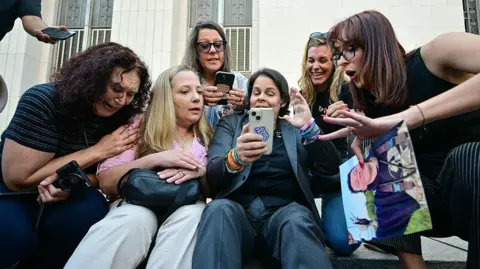
Parents of other children, who are not part of Kaley’s lawsuit but claim they also were harmed by social media, were outside the courthouse on Wednesday, as they had been many days throughout the five-week trial.
When the verdict came through, parents like Amy Neville were seen celebrating, and hugging other parents and supporters who had been waiting for a decision.
The LA verdict came a day after a jury in New Mexico found Meta liable for the way in which its platforms endangered children and exposed them to sexually explicit material and contact with sexual predators.
Mike Proulx, a research director for advisory firm Forrester, said the back-to-back verdicts underline a “breaking point” between social media companies and the public.
In recent months, countries such as Australia have imposed restrictions for children to stop or limit their use of social media. The UK is currently running a pilot programme to see how a ban of social media for people aged under 16 may work.
“Negative sentiment toward social media has been building for years, and now it’s finally boiled over,” Proulx said.
Reacting to the verdict, Prime Minister Sir Keir Starmer said the status quo was “not good enough” and more needed to be done to protect children.
Highlighting the government’s consultation asking whether to ban social media for under-16s, he said: “It’s not if things are going to change, things are going to change.
The question is, how much and what are we going to do?”
Meanwhile, the Duke and Duchess of Sussex, who have campaigned at length about the harms of social media, called the verdict a “reckoning”.
“Let this be the change – where our children’s safety is finally prioritised above profit.”
British online safety campaigner Ian Russell, whose 14-year-old daughter Molly took her own life in 2017 after consuming harmful content online, told the BBC’s Newsnight programme: “There is a big hope that this is a big moment and tech will… [need] to change, but only if the governments do something about it.”
During his appearance before the juryin February, Mark Zuckerberg, Meta’s chairman and chief executive, relied on his company’s longstanding policy of not allowing users under the age of 13 on any of its platforms.
When presented with internal research and documents showing that Meta knew young children were, in fact, using its platforms, Zuckerberg said he “always wished” for faster progress to identify users under 13. He insisted the company had reached the “right place over time”.
While Google, as the owner of video-sharing site YouTube, was also a defendant in the case, most of the trial proceedings focused on Instagram and Meta.
Snap and TikTok were also initially defendants, but both companies reached undisclosed settlements with Kaley prior to trial.
As for Kaley’s lawyers, they argued that Meta and YouTube had built “addiction machines” and failed in their responsibility to prevent children from accessing their platforms.
Kaley said she started using Instagram aged nine and YouTube aged six, and encountered no attempts to block her because of her age